Showing posts with label core wounding. Show all posts

Tuesday, 1 July 2014

Core wounding, shame and connection

Core wounding. Those deep entrenched, often hidden, beliefs that let us scupper ourselves time and time again. 
I first came across all this when I did a course of Rebirthing, absolutely ages ago.  I’d always felt that my ‘core issue’ was abandonment – and that it had kicked in when my father died (when I was ten).  I blamed my inability to form relationships on it – it was a handy tag. I'm not so sure about that any more.  
Rebirthing, however, looks for stuff that happened during or around your birth, or even before it.  I remember asking my mother if there was anything else I should know and she told me, very honestly, very bravely, a shedload of stuff that isn’t mine to share here.  But it sideswiped me.  Left me horrified and humbled.  And it made me realise that my core issue is probably quite different.  That, at heart, it was – and maybe still is - Shame. 
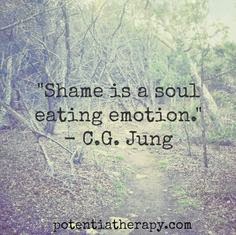
What does Shame say?  Shame says ‘You’re a mistake, you’re disgusting, you’re bad, you’re revolting.’  What does Shame do?  Shame makes one overly nice and giving, overly scared of hurting people, scared shitless of being exposed as a fraud.  Shame makes one a desperate over-achiever, a perfectionist, ever-anxious, ever-fearful.  Shame makes one a coward.

Actually we didn’t really look at core wounding at The Pause.  But something Danielle said struck a core-chord.  ‘Being more connected is a helpful way to be in the world.’  And that sense of connection was something that came up strongly for me at The Pause.  Being totally alone is bloody lonely – but it’s also safe.  If you don’t share yourself with others, if you keep hidden in your little hermit shell, if you push everyone away, if you tell everyone to fuck off (whether overtly or covertly), then you don’t need to confront yourself out there, do you? You can hold tight to your safe little world.  
Yet, though sharing is scary, it can also be a relief.  I was surprised to meet with such acceptance within our little group, amazed that they looked at me and didn’t see the monster within. 
Ach, psycho-babble, jibber-jabber , mindless mind games and so on and so forth, huh?  But still, I feel there’s something in it.  Because we’re little psychic sponges, we really are – and, even if nothing is said, nothing overt, we pick up atmospheres, we read the wind.  And, no matter how much you like to think you’re an island, this stuff does have an effect on how your life pans out, in particular how you relate to other people.  What messages did you pick up as a baby, I wonder?  What are your core beliefs?

Might it be abandonment (nobody cares about me, I don’t matter, I can’t trust); inferiority (I’m not good enough, I’m stupid, I’m boring); rejection (I’m a burden, nobody wants to spend time with me, I’m unwanted); damage (something’s wrong with me, I’m a failure), or maybe arrogance (I’m too much; I’m right, you’re wrong)?  Something else entirely?

What messages were drilled into you from an early age?   It’s curious but there are some people who, from what they say, had idyllic beginnings – parents who wanted them wholeheartedly, who loved them deeply from the get-go, who were the epitome of Love and Caring and Devotion.  And yet…

Anyhow, just musing out loud again.  What do you reckon? 


Saturday, 28 June 2014

True Love, primal yurts and the people who're airbrushed out of fairy tale books

While I was at The Pause I read Call Off The Search by Anna (Pasternak) and Andrew Wallas.  Why? Because Danielle suggested I might find it interesting.  She runs courses with Andrew Wallas and says he’s a good guy.  So I did.  It wasn’t as if I had anything else I was burning to read: I haven’t read anything lately that has rocked my boat, that has really made me think or feel. 

It seemed a bit familiar and then I remembered that I’d read an extract from it in a supplement when it first came out.  It had annoyed the hell out of me.  So I guess that’s one very good reason to read it, huh?  What annoyed me?  Well, the book is all about how you shouldn’t ever give up on a relationship; that you have to work through the fights and the anguish and the tough times.  That love relationships can easily call up your ‘core wounding’ – that early first pattern of hurt and disappointment we suck in with our mother’s milk – and offer a wonderful opportunity to heal at a deep, primal level.  Which is all very stoic and good except that…Andrew Wallas left his relationship.  He told Anna Pasternak she was a posh spoilt insecure bitch, got her sobbing in his yurt and then had this sudden ‘ka-boom!’ realisation that she was his One True Love.  So, what did he do?  He left his wife.  Just like that.   All very amicable apparently but still…

Marriage neatly dissolved, the whole book is all about how he and new ‘True Love’ Anna work out their stuff.  It's about how they fight and bicker and nearly break up all the time, how they love each other but also sometimes hate each other; and how that can all change in a heartbeat.  Bottom line, they just slog it out with brutal honesty.  Which is great.  I mean, good for them…but, but, but… all the way through I was left wondering ‘And what about his ex-wife?’ 
The relationship, he says, was ‘emotionally empty’.  So then, it’s okay to walk out of a relationship if it’s ‘emotionally empty’?  I dunno, it just seemed all a bit too convenient somehow.  How do you know if your relationship is ‘emotionally empty’?  Maybe emotionally empty is a manifestation of core wounding?  Bottom line, how do you know if it’s doomed, terminal, that it’s time to pack up your yurt and move on, or whether you should stay, drive in your yurt pegs a bit deeper and sledgehammer away at it?  A&A just don’t answer that question.  So I was left pondering it myself. 

Maybe it’s about a ‘charge’?  If a relationship still has ‘juice’?  As the saying goes it’s a thin line between love and hate but both are positive emotions, right?  As in emotions that have a positive charge, that are powerful, punchy, full-on.  I’ve always felt that the true opposite of love isn’t hate but apathy.  If a relationship has become apathetic, if the parties involved are just going through the motions, presumably that is what A&A are calling time on?  Can you give apathy an adrenalin shot?  Can you juice it up?  Or should you just sigh and move on?  What if your core wounding has left you unable to love?  


I don’t know. I really don’t.  All I know is that, all through the book, I kept wondering when we were going to hear about his first marriage.  I wanted to know what happened to his ex-wife.  Did she find ‘True Love’ as well, or is she sitting somewhere reading the book and shoving her fingers down her throat over each gushing paragraph?  How did she feel when he told her it was all over?  Was she gutted or secretly relieved?  Did she punch the air and go, ‘Yessss!  I always hated that fucking yurt!’ 

I guess I wanted to hear about how one lives when the projections of falling in love fall away.  That, to me, is the more interesting question.  A&A are clearly still madly passionately in love.  Will they still feel the same way in twenty years? Is that True Love?  What is? 

I wasn’t intending to write this blog post.  There was a bit in the book, a concept that intrigued me and I was going to blog about that but this came out instead.  But, hey, it is what it is.  What do you think?